In this article, we will understand the design procedure with the help of simple examples of the reinforcement detailing for the oneway slab.

One-way slabs are crucial in structural egg., serving as essential components in building and infrastructure construction. Their primary function is to transfer loads from the superstructure to the supporting elements efficiently, ensuring overall stability and safety. Understanding the design procedure for one-way slabs is crucial, especially as per IS 456: 2000, the Indian design code. This understanding enables them to create structurally sound and economically viable solutions while adhering to the prescribed standards and regulations.
We will walk through the detailed design process of a simply supported one-way slab with specific parameters.
The slab has a clear span of 3.5 m and is subjected to a live load of 3.5 kN/m2 and a floor load of 1.5 kN/m2. The supporting wall has a width of 0.23 m. For our design calculations, we will assume M20 concrete and Fe415 steel, commonly used materials in construction.
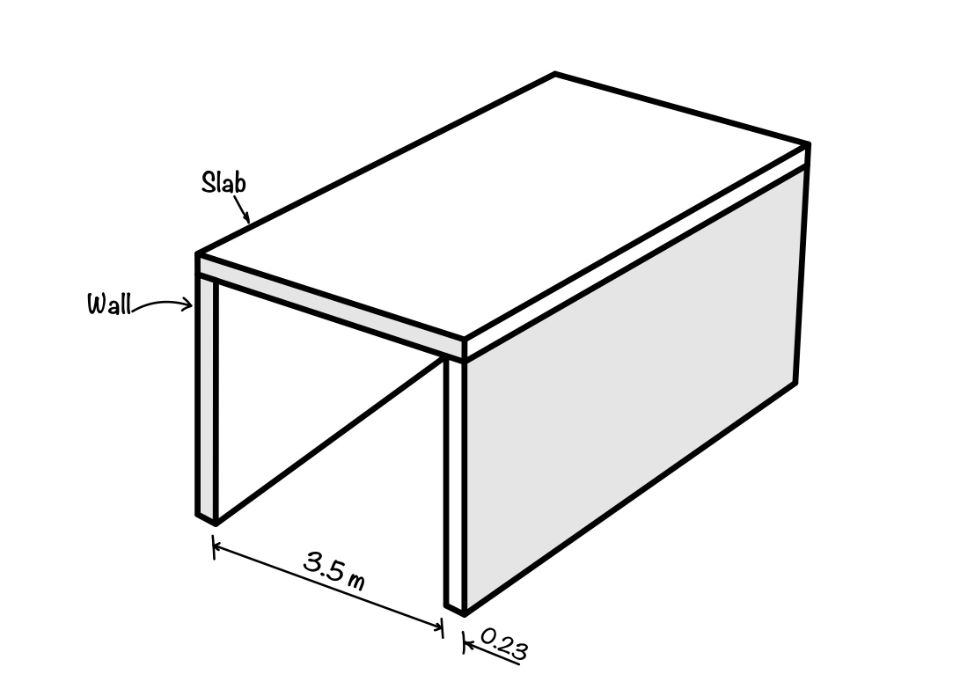
Check this post to learn the detailed step by step procedure of one way slab.
Assuming approx. depth;
Let's assume D = 180 mm and cover = 20 mm for mild exposure condition.
So, lets take the depth as 180 mm = 0.180 m
Now effective span is taken as lesser of two ;
or
So, take effective span as 3.655 m
Consider the various loads due to
Self weight: Self load refers to the weight of the structure itself, including the weight of the material used in construction and any fixtures or furnishings
Dead Load: To refer to the permanent and stationary weight of a structure and its components.
Live load: The temporary or movable loads that a structure or building is prone to during its use or occupancy.
Total load : Calculate the total load and factored load (1.5 * Total load)
Calculate the bending moment using the formula
i.e., we also have to calculate the depth based on the maximum moment values
< 155 mm. OK.
Compute the value of Ast using the formula : \frac{p_t}{100} = \frac{A_{st}}{bd} = \frac{f_{ck}}{2 f_y} \[1 - (1 - 4.598 \frac{R}{f_{ck}})^{0.5}\]
i.e.,
Now, we compute the value of Ast as:
If we are using 10 mm dia. bars, then the spacing of the bars is calculated using the:
Hence use 170 mm spacing c/c, which is less than 3d or 300 mm.
According to IS 456:2000, the minimum % of steel for Fe 415 is 0.12 %, which is provided as distribution steel.
If we are using 8 mm dia bars, then the spacing of the bars are computed using :
Hence use 230 mm spacing c/c, which is less than 5d or 450 mm.
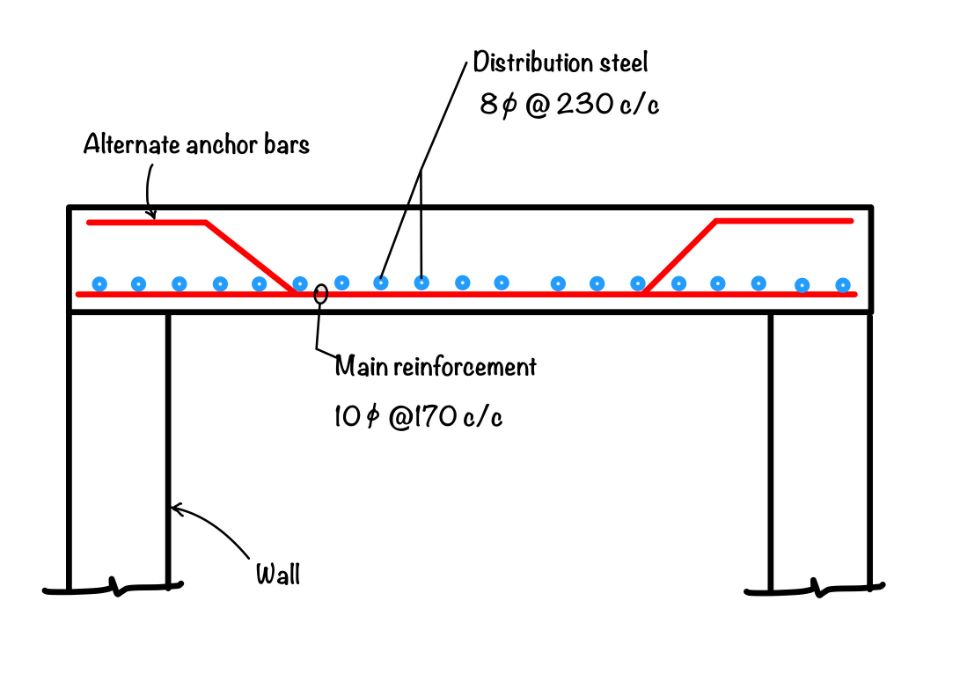
In this blog post, we have delved into a practical problem that provides an explanation of a one-way slab. As per IS:456:2000, Indian Standards, we have designed a simply supported rectangular one-way slab section.
So, let us discuss the key points from this problem as follows:
Significance of Design and Analysis: It gives the need to consider various factors, including load distribution, and reinforcement to ensure the function of a one-way slab.
Consideration of Critical Factors: Throughout our design procedure, we have discussed significant factors such as bending moments, shear forces, and deflection limits.
Integration of Theory and Practice: All in one, by following the reinforcement detailing guidelines as per Indian codes, engineers can develop structurally sound and efficient solutions that meet safety and performance criteria.
Your trusted source for latest updates in core engineering and scientific computing.