In this article, you will learn how to calculate the tensile strength capacity of flat plates with the block shear calculations.

Tension members are those which are subjected to tensile force. In this article, we will focus on the determination of the tensile strength of the simplest tension member that is flats. By Indian standards, flats are denoted as ISF which means Indian standard flats.
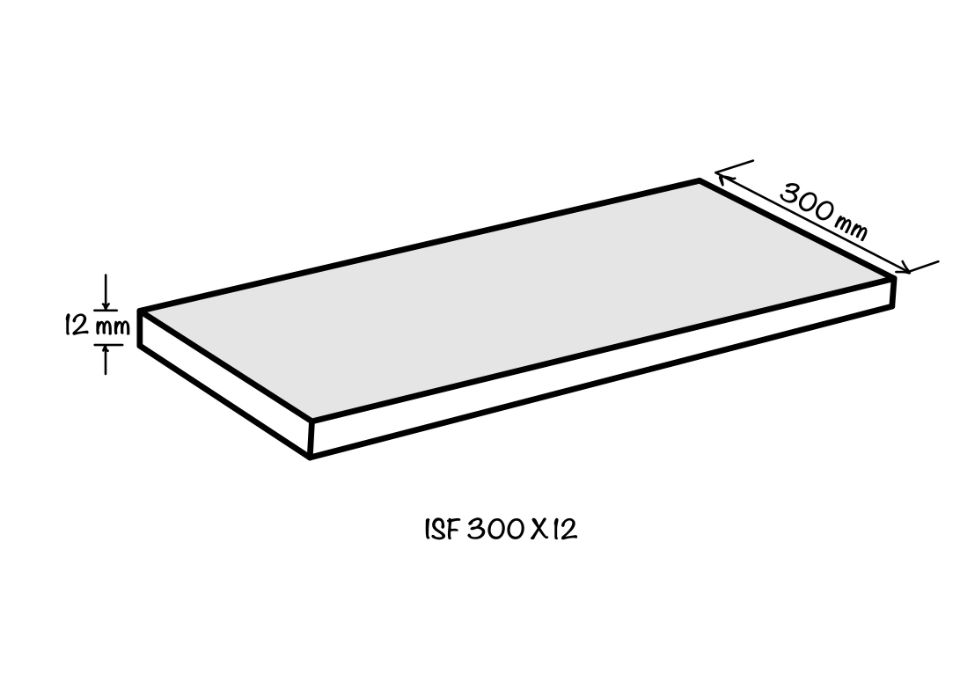
Tension members are linear members in which axial forces act to cause elongation (stretch). These type of members has a wide range of applications in buildings an other civil engineering structures. Now, let us look into the failure modes of tensile members.
This article is only applicable for plates subjected to tensile load but not for any other structural shapes (Angle sections, Channel sections)
Tension members can undergo three types of failure mode:
a) Design strength due to yielding of the gross section
b) Design strength due to rupture of critical section
c) Design strength due to block shear
Thus, design tensile strength,
Now let us calculate each of the design strength by taking a design example.
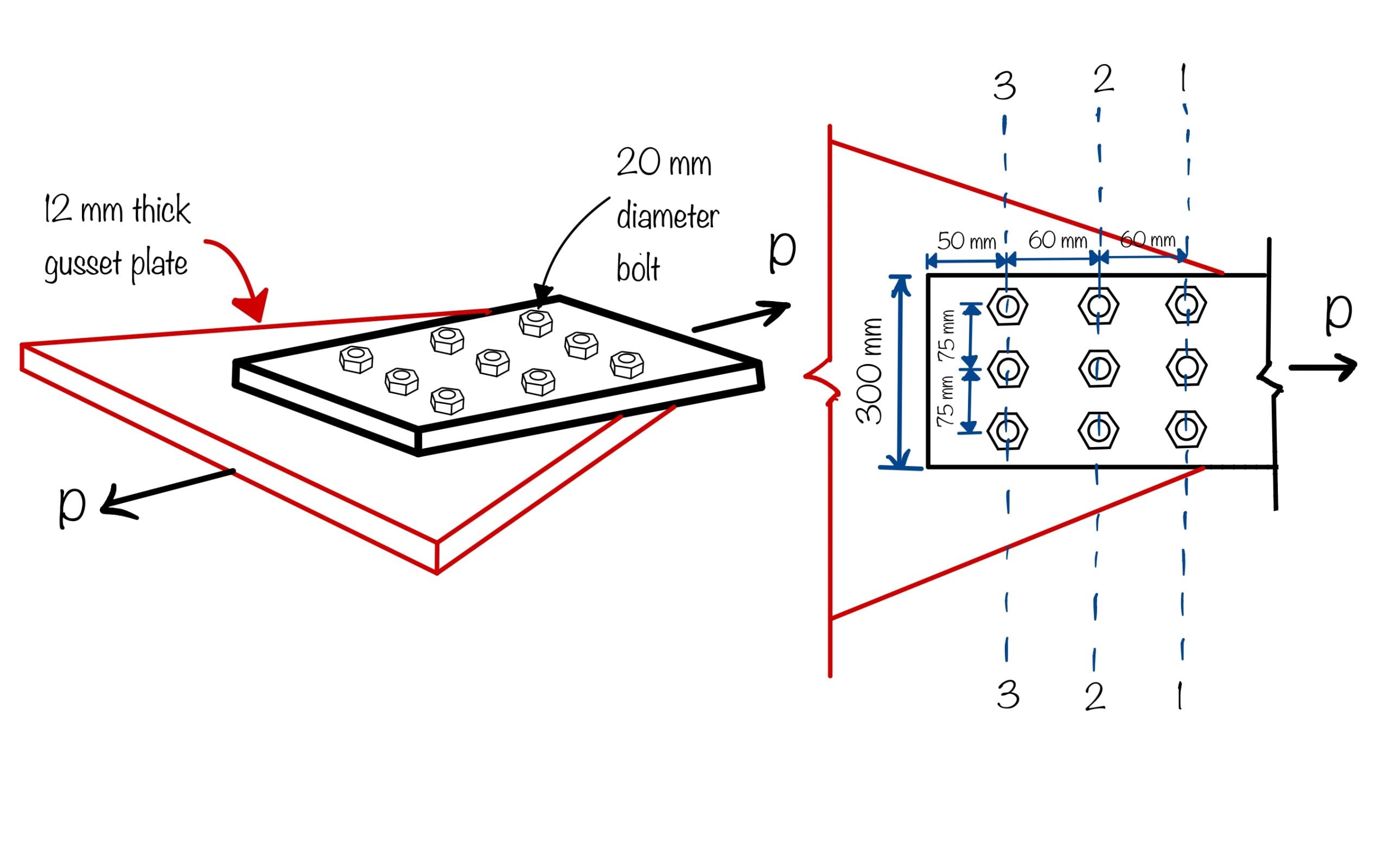
A flat plate, 300 ISF 8 mm of grade 410 is connected to a 12 mm thick gusset plate by 18 mm diameter bolts of grade 4.6. Calculate the design tensile strength of the member. The bolting pattern is shown below.
As per IS 800:2007, the design strength of member governed by is given as:
where,
yield stress of the material
gross area of cross-section
partial safety factor for failure in tension by yielding (Table 5, IS 800:2007)
In the current design example, for 300 ISF 8 mm we have,
Width of the plate,
Thickness of the plate,
Hence,
Therefore,
As per IS 800:2007, the design strength of member as governed by is given as:
where,
Ultimate stress of the material
Net effective area of cross-section
partial safety factor for failure at ultimate stress (Table 5, IS 800:2007)
The net effective area, of a cross-section is basically the expected path of rupture of the plate when subjected to tensile load. Thus, it will fail through the bolt-hole path (staggered or linear) for the lowest effective net cross-section area.
IS 800:2007 defines net section area for flat plates as:
A_n=\[b-nd_h+\Sigma\frac{p_{si}^2}{4g_i}\]t
where,
width and thickness of the plate respectively,
diameter of the bolt hole
gauge length between bolt holes (centre-to-centre distance of the bolt measured perpendicular to the direction of applied load)
staggered pitch length between bolt holes, as shown in figure below.
number of bolt holes in the critical section
subscript for summation of all the inclined legs
Note: Here, the term is used only for staggered type bolting pattern.
In the given example, the bolting pattern is chain type for which the critical section will be governed by:
A_n=\[b-nd_h\]t
Here,
i.e. as per Clause 6.3.1 IS 800:2007
Hence, A_n=\[b-nd_h\]t=\[300-3\times22\]\times8=1872\; mm^2
Now,
As per IS 800:2007, the design strength of member governed by is given as:
How to calculate the and we will see in the next step
Now we will see the calculation of $T_{db_2}
where,
yield stress of the material
ultimate stress of the material
minimum gross and net area in shear along bolt line parallel to external force respectively (refer to figure shown below)
minimum gross and net area in tension from the bolt hole to the end bolt line (to toe end in case of angle), perpendicular to the line of force (refer to figure shown below)
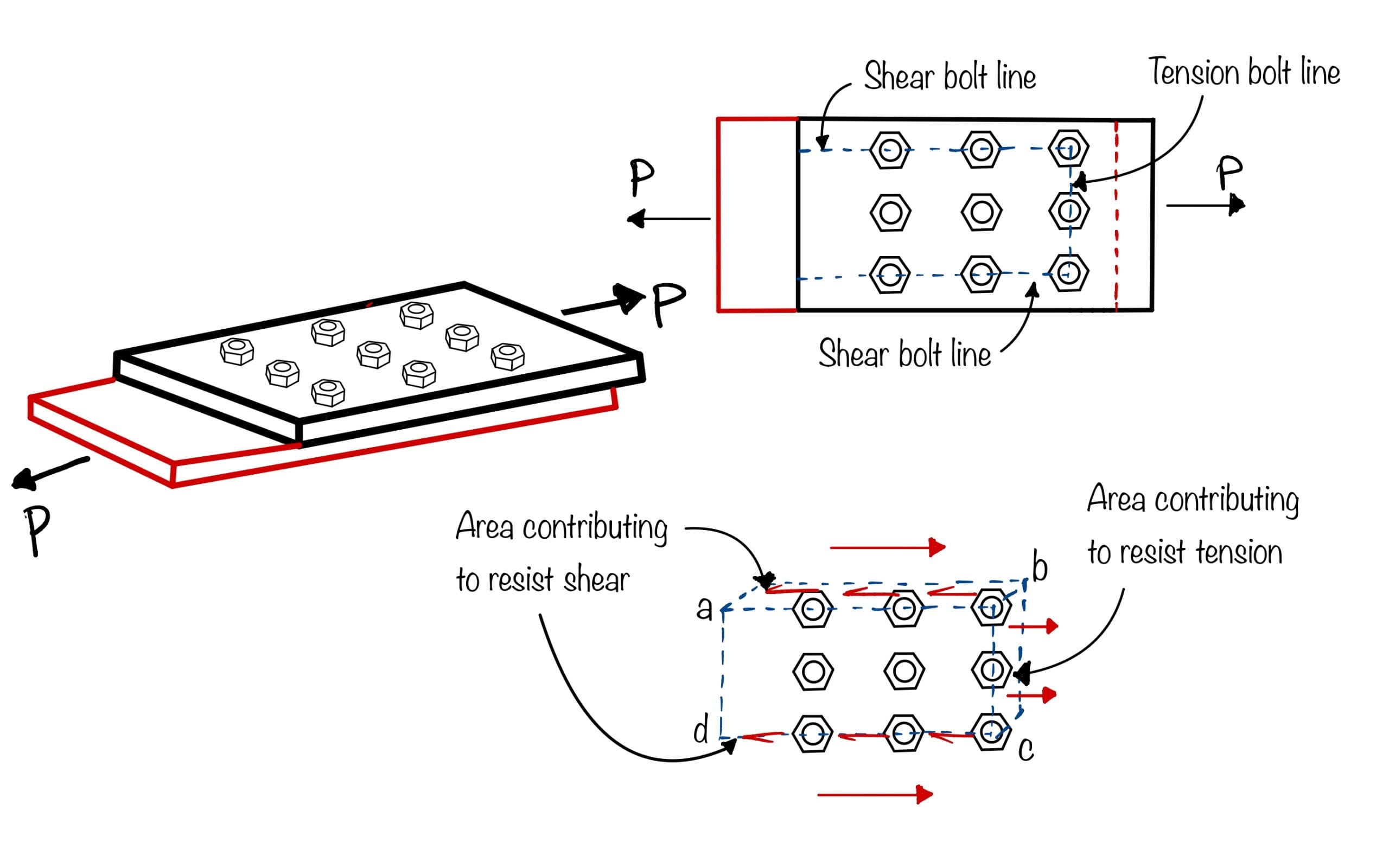
Step a: Determine the shear bolt line and tension bolt line
Refer to figure below on simple tricks to determine the shear and tension bolt lines. Clause 6.4.1 of IS 800:2007 defines the same in detail.
Step b: Calculate for the given problem
In the given problem,
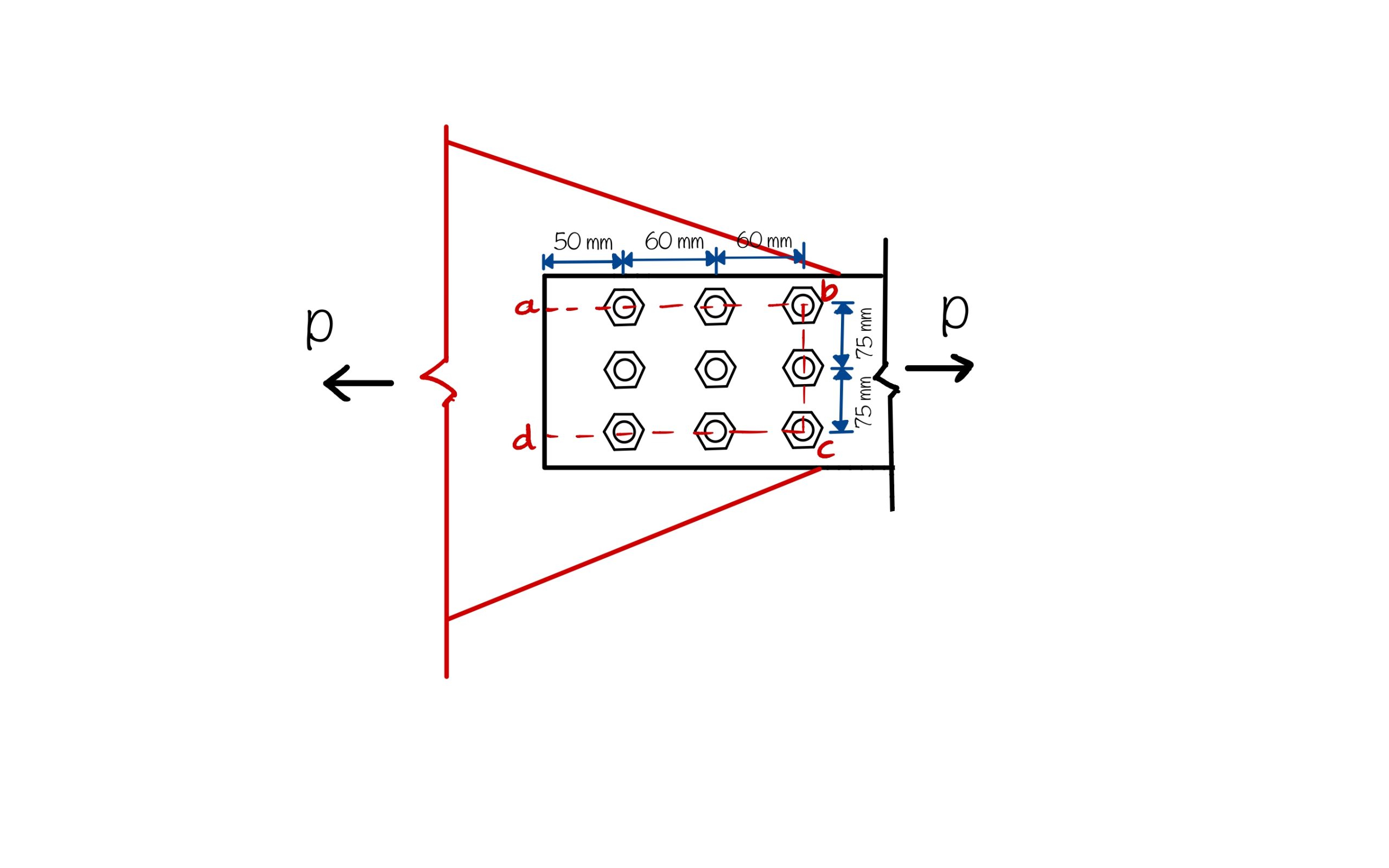
Gross area along and =2\times\[(50+60+60)\times8\]=2720\; mm^2
Net area along and = 2\times\[(50+60+60-2.5\times22)\times8\]=1840\; mm^2
Gross area along
Net area along
Therefore,
Now putting the values in the formula
After calculating the now move to the
Hence,
Thus, design tensile strength,
In this article, we have seen how to obtain the tensile strength of a flat plate with a chain bolting pattern with a design example.
A few learning points are:
Failure modes: Tension member can fail in three modes: Yielding, Net-section rupture, and Block shear failure
Strength: Determination of net section area, is an important step in design strength calculation.
Your trusted source for latest updates in core engineering and scientific computing.