To extend the bars we need to add them in the field. This process is called splicing. In this post we will discuss this according to IS456.

When you want to extend the rope, what do you do? You take two ropes and tie them, and now you have a long rope. While selecting the rope, make sure that both ropes are of equal length. The knot is perfect for transferring the load from one to other. This is called splicing.
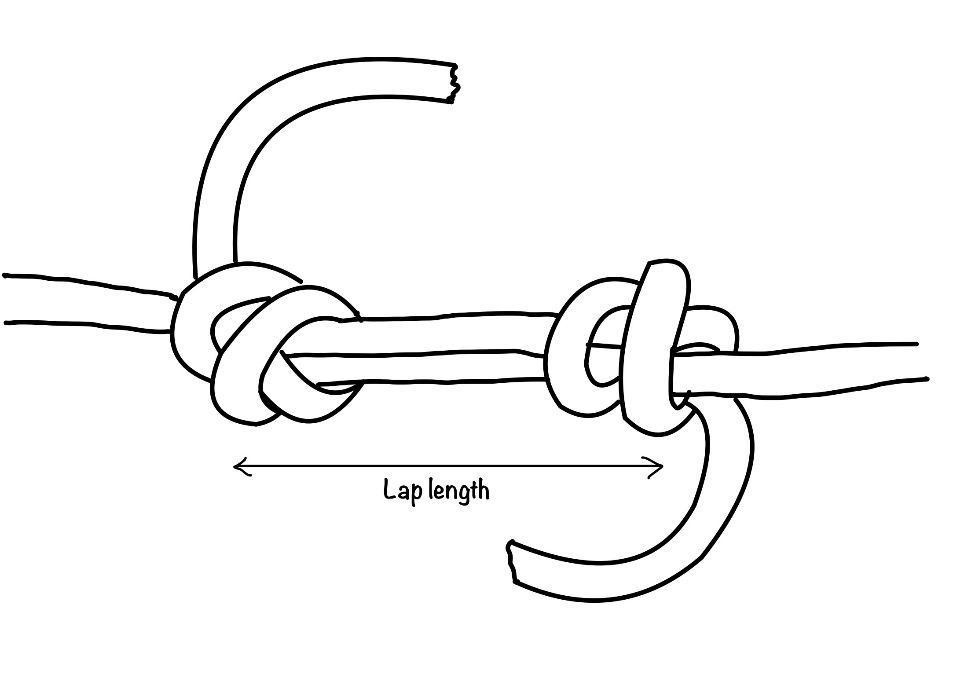
The joining of two ropes is called splicing. And the like in rope you have considered different. Checks that apply in RCC also. Here rope is replaced by bars. This post will teach you why we need splicing and other provisions.
Most of the time, the length of the bar required is not available in the market. In this situation, the solution is the join the bars. To tie the bars, we need to overlap them with the old bar. This joining of two bars is called splicing of the bar.
There are many concepts involved regarding the splicing of bars which we can discuss. Like how to join them, where to join them and how much overlapping length is required.
Depending upon the load transfer mechanics on bars, splices are of two types:
Direct splices: Direct splices transfer force from one bar to other without straining the surrounding concrete. Welded and mechanical couplers are examples of such direct splicing.
Indirect splices: In indirect splice bar transfer the strain to surrounding concrete and than to another bar. The bond between the bar and concrete is used as the transfer mechanism. Such transfer results in the stress concentration and the cracking of concrete.
Most of the time, we generally prefer indirect splices. As we have discussed, the indirect splices lead to the cracking of concrete. We need to take some measures to avoid this.
To avoid the cracking of concrete we use following methods:
Technique: Use of proper splicing technique should be used.
Location: We must keep the its location away from critical points like from high flexure or shear stress zone.
Staggering: By intentionally planning the location of splices so that they will not come at the same location.
IS456 list several rules for the length of lap . We will discuss the rule from IS456 in simple language.
For applying the different provisions, we need to calculate the lap length of the bars.
According to IS456, the lap length is considered as greater than follows:
The lap length for the bars in tension increases by in the following conditions.
When the tension reinforcements are at the top, and the minimum cover is less than twice the diameter of the lapped bar.
When tension reinforcements are at the corner of the section and minimum cover is or where the clear distance between the adjacent lap is (greater of mm or ) ( is dia of the lapped bar).
When both conditions exist, the factor should be .
Lap length in compression:
Lap length for bundled bars:
To control the cracks in the structure we need to stagger the splicies. IS456 gives the definition of staggering in terms of lap length. When the center-to-center distance of the splices is not less than . Lap length we have calculated as above.
It is the joining process. Whether we join the rope or bar. In this case, we have the bars, and unlike the rope, we can not make the knot in the bars. Short bars are easy to work with in the field hence it is necessary to splice them.
In this post, you have learned the following key points:
Splicing: It is the joining process to extend the bars.
Cracks: Indirect splices generate cracks in the concrete. Hence to control the cracks, we want to stagger splicing.
Lap length: Lap length is an important parameter to control splicing. You have learned to calculate the lap length for different cases according to IS456.
Your trusted source for breaking down core engineering concepts using first-principles thinking.