In this article, we will learn the different types of steel beam and the types which we use and also the commonly used section as beams.

We technically call the beam a flexure member. That means it resists the load by flexure action which we can understand with a simple object lying on our table that is the eraser. Try to bend the eraser it will bend as shown in the figure and in this phenomenon it produces the moment of resistance as shown in the figure.
In this article, we will learn about the beams made up of steel. The steel beam has high strength hence generally we provide a slender section, which leads to different types of problems in steel beams.
As we have discussed earlier that the structural member which we load by the transverse loads (perpendicular to the longitudinal axis) which transfers its effect by bending is called a beam.
We can classify the beam as follows:
Floor beam: A major beam of a floor system usually supporting joists in building.
Girder: A large beam supporting a number of joists is the girder and is the most important beam.
Joists: A beam supporting floor construction but not major beams.
Lintels: We cast the beam to support the opening for doors and widows are lintels. They carry the wall load above it.
Spandrels: Exterior beams at floor level of buildings, which carry part of floor load and the exterior wall.
Purlins: These are the beams in the roof system which carries the roof load in trusses.
Rafter: These are the roof beams which support the purlins are rafter.
As we have discussed in the previous article that we are about to design the steel beam in this article. Hence, we will the different type of criteria in this section which you need to check.
We will divide them as primary and secondary criteria for the design of the beams.
Primary criteria for the design of the beams are as follows:
Bending: As we know that we are designing beams here, hence bending is the primary criteria in which we have to check the safety of the beams.
Shear: Shear is the very important in case of steel beams. As we design the steel beams for heavy load. These heavy loads generates high shear force and hence high shear stress in the beam.
Deflection: As we have discussed already that the steel beam has high strength, which gives us the slender section from the strength point of view. That means the deflection is the important criterion for the design of steel beams.
Apart from the primary criteria secondary criteria is also important for the design of the beam.
Secondary criteria for the design of the beams are as follows:
Local buckling of flange plate: As we have discussed earlier also the beam section is very slender it may lead to buckling of the flange plate. As the buckling of flange plate is the local phenomenon we call it local buckling.
Web buckling: When the web of the section fails in buckling we call it web buckling.
Web crippling: Due to high shear stress in the steel beam it may lead to failure in the web near the flange section. It happens because the area bearing the shear force suddenly reduces which leads to shock in the web.
As we have discussed already that the beams resist the transverse loads through the flexure action. This flexure action is also known as the bending action. The details of the bending action are discussed in the article. This article concludes that the section which has a higher moment of inertia about the axis or about the axis (depending upon the bending) is better to be used as the beam.
Hence, after this conclusion, we can now discuss the frequent sections which we can use as the beams. Based on primary geometry sections can be classified as open and closed. This sections are shown in the figure.
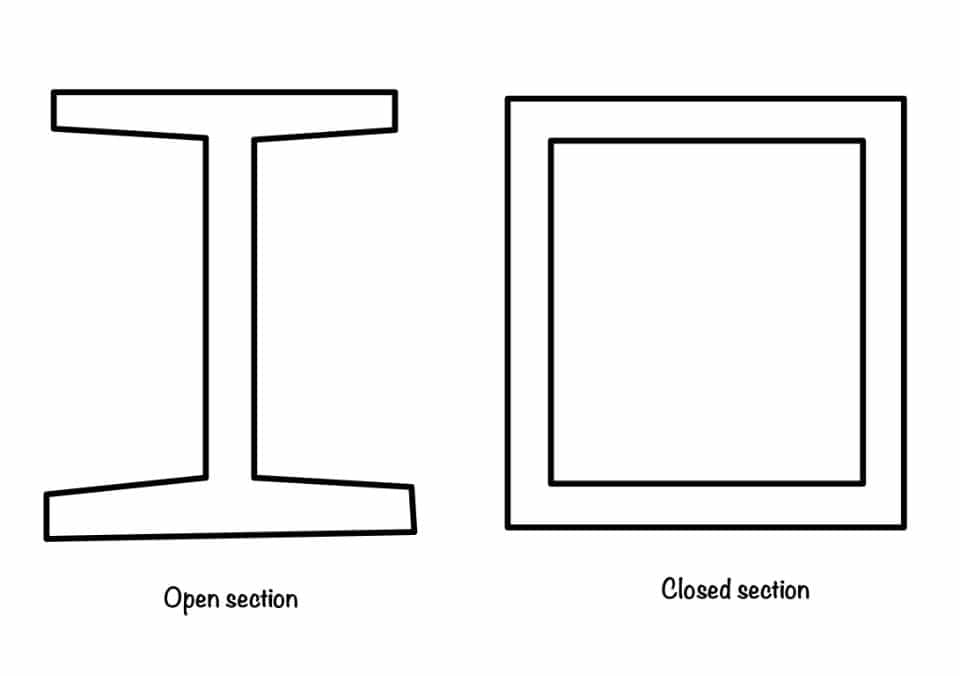
The closed section which we have discussed above has high torsional stiffness but practically it is very difficult to use this. Because it is difficult to connect them with the other members.
After this we will see the rolled sections. Rolled section is preferred as beam. Apart from that the rolled channel and angles we sometime use for beams subjected to light weight like purlins.
For making the bridge girder we generally prefer the built up I sections. If these sections are also not enough than we can use the plate girders.
In this section we have discussed the primary ideas about the steel beam and different practice which we generally follow in the steel construction in the field.
The key learning points which you have learned in this post are as follows:
Your trusted source for latest updates in core engineering and scientific computing.