Tensile strength of the flat plate depends on the net area. In this article we will learn how to calculate net area for staggered bolting.

In the previous articles, we have seen design examples of finding the tensile strength of flat plate with Chain pattern bolting. In this article, let's explore the difference for staggered bolting patterns.
The difference lies in the arrangement of the bolting. As the name refers, chain bolting is the simplest form of bolting where the number of bolts required to resist the forces are arranged in a series form. Any chosen row or column in the bolt group will have same number of bolts.
Whereas, in staggered bolting, the number of bolts required can be arranged in any shape such as diamond, star, rhombus.
For tensile members, the net area reduction due to bolt holes influences the design tensile strength due to rupture (Clause 6.3.1 IS 800:2007). In such a case, when the number of bolts requirement is higher and the dimension of connection length is a constraint, the bolts can be arranged in a staggered fashion to minimize the reduction of cross-sectional area.
The only design strength calculation factor that changes from the usual design strength calculation of flat plates with chain bolting (refer to article XXYYZZ) is the determination of net effective area of cross-section.
As per IS 800:2007, for staggered bolting pattern,
A_n=\[b-nd_h+\Sigma\frac{p_{si}^2}{4g_i}\]t
where,
width and thickness of the plate respectively,
diameter of the bolt hole
gauge length between bolt holes (centre-to-centre distance of the bolt measured perpendicular to the direction of applied load)
staggered pitch length between bolt holes, as shown in figure below.
number of bolt holes in the critical section
subscript for summation of all the inclined legs
A flat plate, 300 ISF 8 mm of grade 410 is connected to a 12 mm thick gusset plate by 20 mm diameter bolts of grade 4.6. Calculate the design tensile strength of the member. The bolting pattern is shown below.
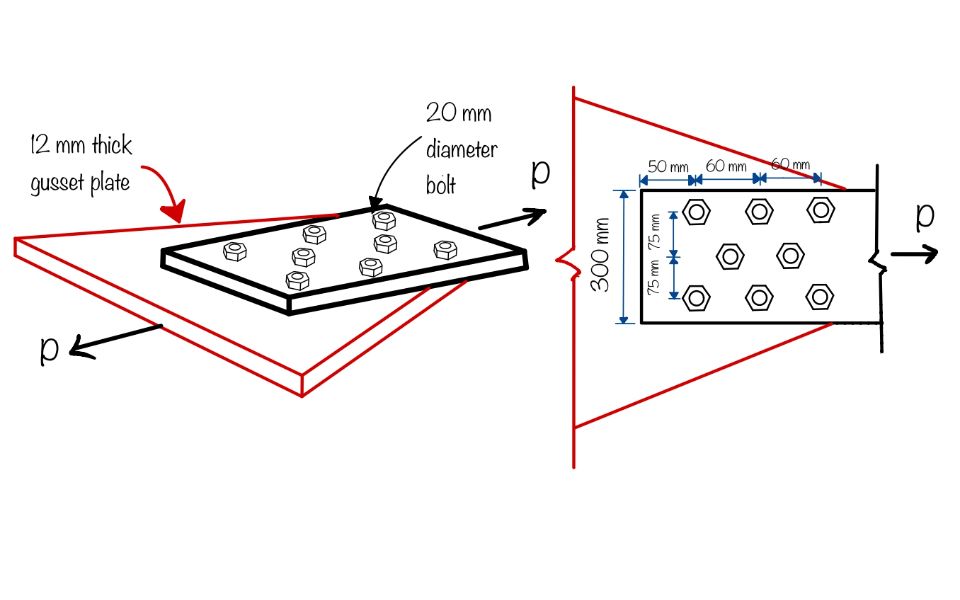
As per IS 800:2007, the design strength of member governed by is given as:
where,
yield stress of the material
gross area of cross-section
partial safety factor for failure in tension by yielding (Table 5, IS 800:2007)
In the current design example, for 300 ISF 8 mm we have,
Width of the plate,
Thickness of the plate,
Hence,
Therefore,
As per IS 800:2007, the design strength of member as governed by is given as:
where,
Ultimate stress of the material
Net effective area of cross-section
partial safety factor for failure at ultimate stress (Table 5, IS 800:2007)
As discussed in the article, the net effective area, of a cross-section is basically the expected path of rupture of the plate when subjected to tensile load. Thus, it will fail through the bolt-hole path (staggered or linear) for the lowest effective net cross-section area.
IS 800 :2007 defines net section area for flat plates as:
A_n=\[b-nd_h+\Sigma\frac{p_{si}^2}{4g_i}\]t
where,
width and thickness of the plate respectively,
diameter of the bolt hole
gauge length between bolt holes (centre-to-centre distance of the bolt measured perpendicular to the direction of applied load)
staggered pitch length between bolt holes, as shown in figure below.
number of bolt holes in the critical section
subscript for summation of all the inclined legs
The focus is to calculate the minimum effective net area through which rupture of flat plate is possible. In such as case, follow the steps:
1) Select from a corner (extreme left or right depending on the pattern of bolting)
2) Select the suitable bolt lines through which failure can happen. For this, the thumb rule is:
a) Failure lines cannot propagate .
b) Draw the lines in slant or downward fashion.
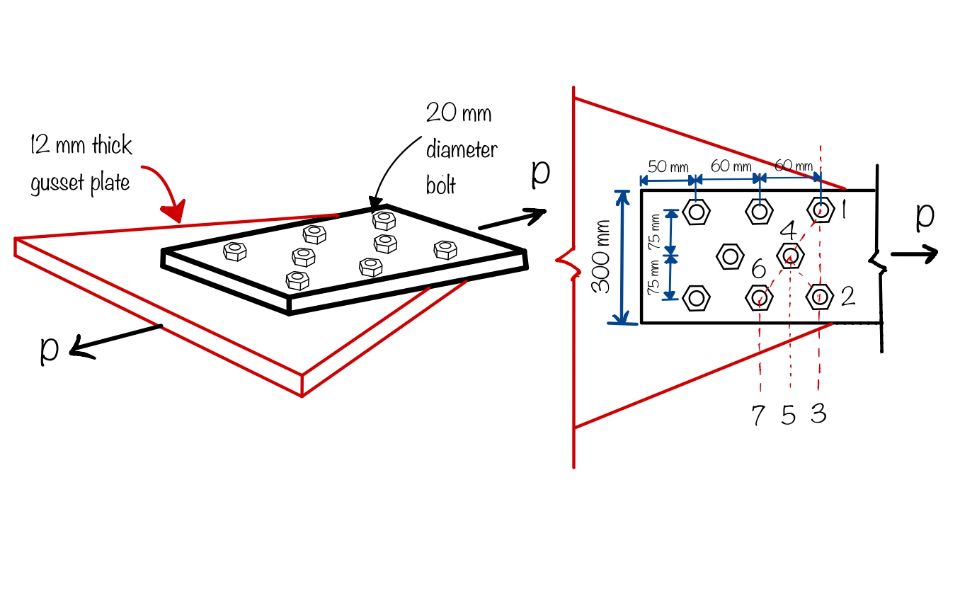
In the given problem, the following failure lines are possible.
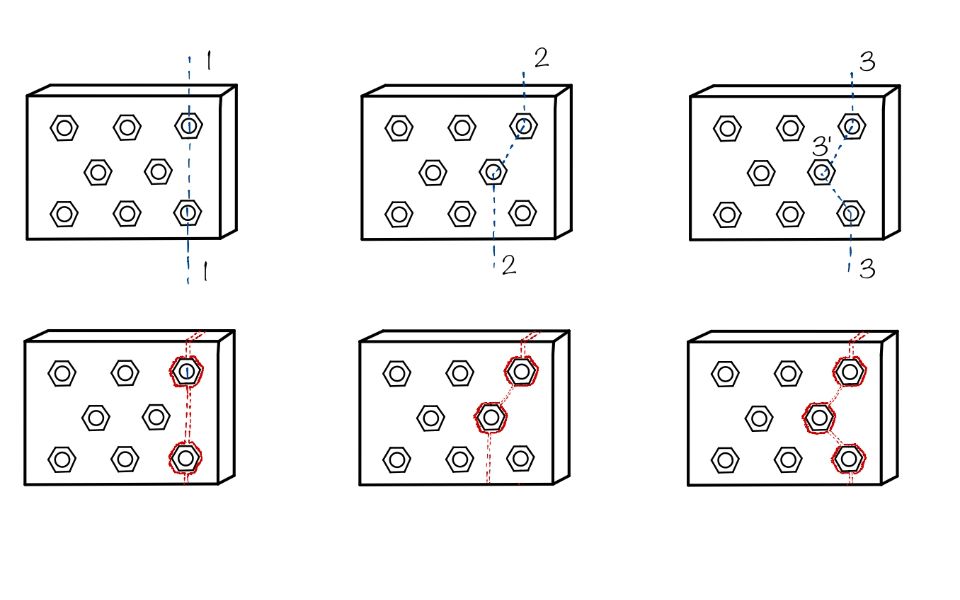
3) Calculate the net effective area as per Clause 6.3.1 IS 800 :2007
For the given problem,
Line 1-2-3
i.e. as per Clause 6.3.1 IS 800 :2007
Hence, A_n=\[b-nd_h\]t=\[300-2\times22\]\times8=2048\; mm^2
Line 1-4-5
i.e. as per Clause 6.3.1 IS 800 :2007
Hence
A_n=\[b-nd_h+\Sigma\frac{p_{si}^2}{4g_i}\]t
A_n=\[300-2\times 22+\frac{60^2}{4\times 75}\]\times 8=2144 \; mm^2
Line 1-4-2-3
i.e. as per Clause 6.3.1 IS 800 : 2007
Hence
A_n=\[b-nd_h+\Sigma\frac{p_{si}^2}{4g_i}\]t
A_n=\[300-3\times 22+2\times\frac{60^2}{ 4\times 75}\]\times 8=2064 \; mm^2
Line 1-4-6-7
i.e. as per Clause 6.3.1 IS 800 : 2007
Hence
A_n=\[b-nd_h+\Sigma\frac{p_{si}^2}{4g_i}\]t
A_n=\[300-3\times 22+2\times\frac{60^2}{ 4\times 75}\]\times 8=2064 \; mm^2
Thus, for the given problem failure will happen in bolt line 1-2-3
Hence,
Now,
As per IS 800: 2007, the design strength of member ruled by is given as:
Now for different cases
Now considering the different case
where,
yield stress of the material
ultimate stress of the material
minimum gross and net area in shear along bolt line parallel to external force respectively (refer to figure shown below)
minimum gross and net area in tension from the bolt hole to the end bolt line (to the end in case of angle), normal to the line of force (refer to figure shown below)
For the given problem,
For calculation of gross shear area and gross tensile area refer to previous article.
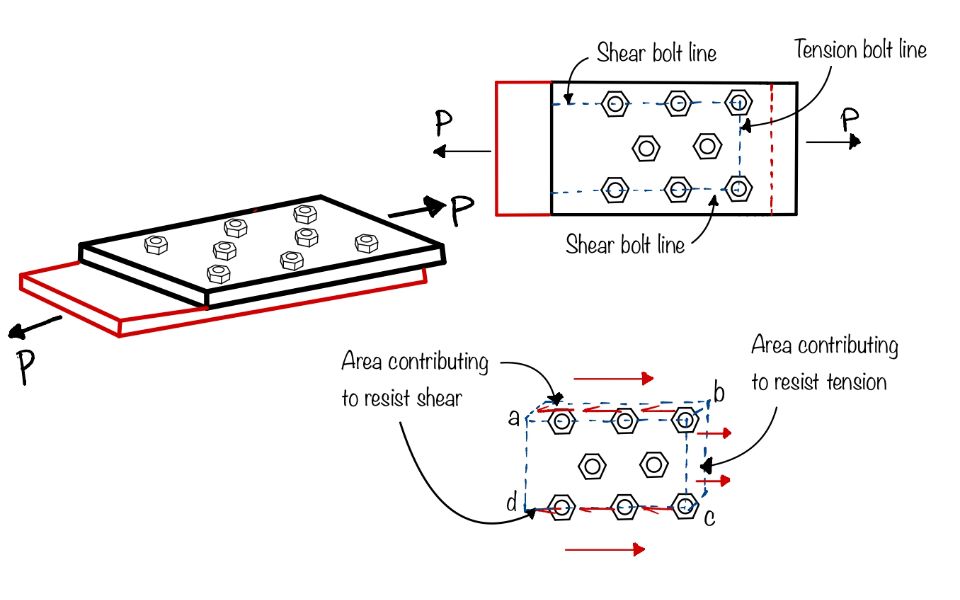
Gross area along and =2\times\[(50+60+60)\times8\]=2720\; mm^2
Net area along and = 2\times\[(50+60+60-2.5\times22)\times8\]=1840\; mm^2
Gross area along
Net area along
Therefore,
Similarly for second case
again
Hence,
Thus, design tensile strength,
In this article, we have seen how to calculate the tensile strength of a flat plate with staggered bolting pattern with a design example. Hence we can compare both types of bolting.
In this article you have learned the following key points:
Net section: Determination of net section area, is an important step in design strength calculation.
Staggered bolting: Staggered bolting minimizes the reduction in net effective area.
Your trusted source for latest updates in core engineering and scientific computing.