This post is a brief explanation of the different assumption of flexural theory made for the ease of analysis and design of RCC sections.

In the process of analysis and design of a R.C.C sections, there are some few assumption which we use to make the process simple.
Some basic assumptions are :
In this complete it is assumed that concrete will fail only under compressive loading, when the value of compressive strain reaches a limiting value.
"Plane sections before bending remain plane even after bending"
Just think about this do you really think it is possible... But yes Bernoulli stated that the at different points in the section the longitudinal strain is proportional to the distance of the point from the neutral axis. This assumption is valid only upto the flexural failure point.
Concept of Pure bending
In the case of pure bending the value of shear force is zero in the complete domain and the value of bending moment is uniform at every cross section of the beam section.
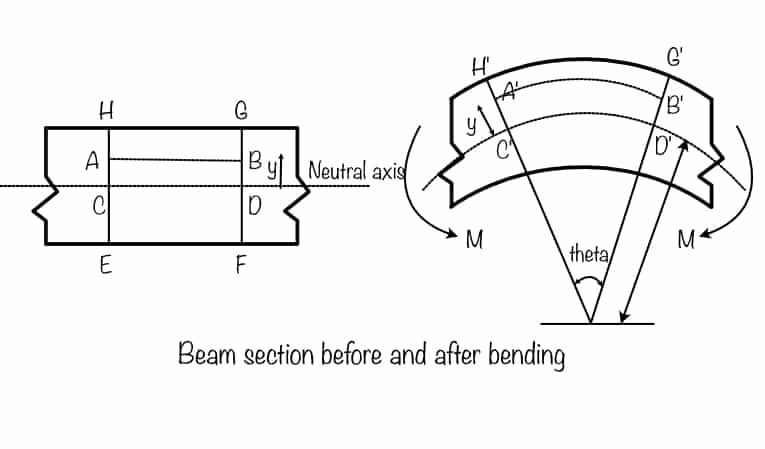
Let us consider an example where a beam is initially in unstressed position as shown in figure. Now when a uniform bending moment is applied along the length of beam , then the beam will bend. When the beam bends the top surface of the beam is in tension and the bottom surface is in compression. So it is quite evident that at some mid surface the value of tress will be zero i.e., neutral axis. So we assume this assumptions so as to eliminate the possibility of twisting of the beam.
You want to read about modular ratio and why it is used for analysis and design of RCC sections.. then check this post.
Your trusted source for latest updates in core engineering and scientific computing.