eigenplus
July 1, 2023steel-design

Shear lag effect in the angle sections

Shear lag effect in the angle section reduces the net cross-sectional area of the member. In this article we will learn about it.

Shear lag effect in the angle sections

In the previous articles, we have seen simple steps to calculate the tensile strength of flat plates for simple and staggered bolting using IS 800:2007. In this article, let's explore the steps for determining the tensile strength of angle sections when bolted to a gusset plate.

Are design equations of angle sections different from that of flat plates? Answer: Yes

As previously discussed in the article, a tension member can fail in primarily three modes:

a) Design strength due to yielding of the gross section(Tdg)(T_{dg})

b) Design strength due to rupture of critical section (Tdn)(T_{dn})

c) Design strength due to block shear (Tdb)(T_{db})

Clause 6.3.1 IS 800:2007 provides design specifications to determine TdnT_{dn} for flat plates i.e.,

Tdn=0.9Anfu/γm1T_{dn}=0.9A_nf_u/\gamma_{m1}

Whereas, for angle sections connected to one leg as per clause 6.3.3 IS 800:2007

Tdn=0.9Ancfu/γm1+βAgofy/γm0T_{dn}=0.9A_{nc}f_u/\gamma_{m1}+\beta A_{go}f_y/\gamma_{m0}

Now the question arises, what is the difference? What is β\beta? The answer is the shear lag effect. Follow the article till the end to know about it.

Shear lag effect in angle sections

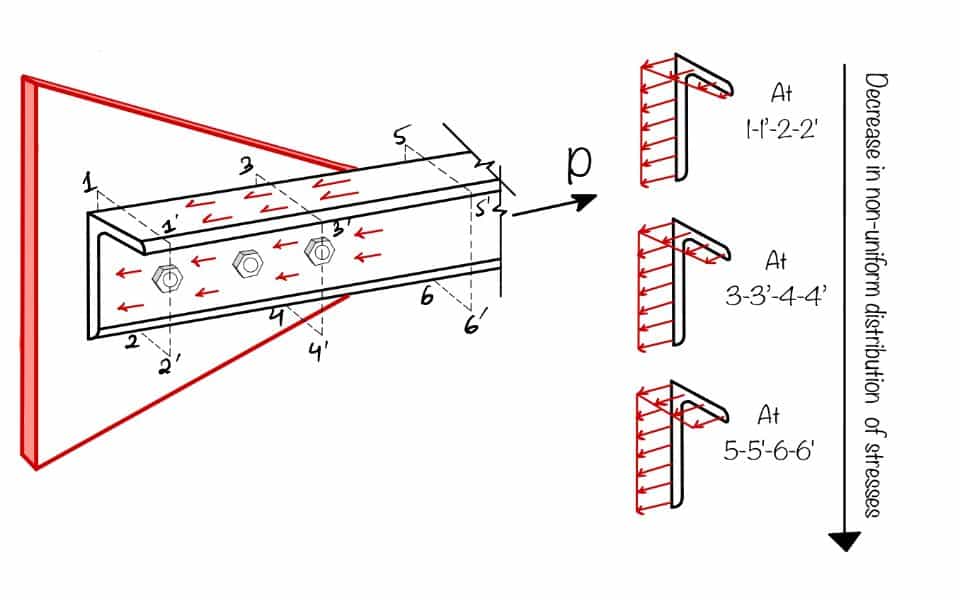
The figure above shows a single-angle section connected through one leg to a gusset plate.

It can be seen from the figure that for a section away from the end connection (Section 5-5’-6-6’), the tensile stress distribution is uniform. Whereas, the tensile stress distribution at the critical section (the section where net effective area of cross-section is minimum, Section 1-1’-2-2’) will be non-uniform.

It is so because the distribution of stresses in the outstanding/unconnected leg takes place through shear forces.

In such a case, the connected leg will have higher tensile stresses(in the order of ultimate stresses) whereas the outstanding leg will be comparatively lesser (in the order of yield stresses)

Because the internal transfer of forces from the connected leg to the outstanding leg happens by shear and the outstanding leg ‘lags’ behind the connected leg in contribution to resist the tensile load, the phenomenon is called “Shear lag”.

IS 800:2007 provisions for shear lag effect

As per clause 6.3.3 IS 800 :2007, for single angle sections,

Tdn=0.9Ancfu/γm1+βAgofy/γm0T_{dn}=0.9A_{nc}f_u/\gamma_{m1}+\beta A_{go}f_y/\gamma_{m0}

where,

β=\beta= 1.40.076(w/t)(fy/fu)(bs/Lc)(fuγm0/fyγm1)0.71.4-0.076(w/t)(f_y/f_u)(b_s/L_c)\leq(f_u\gamma_{m0}/f_y\gamma_{m1})\geq 0.7

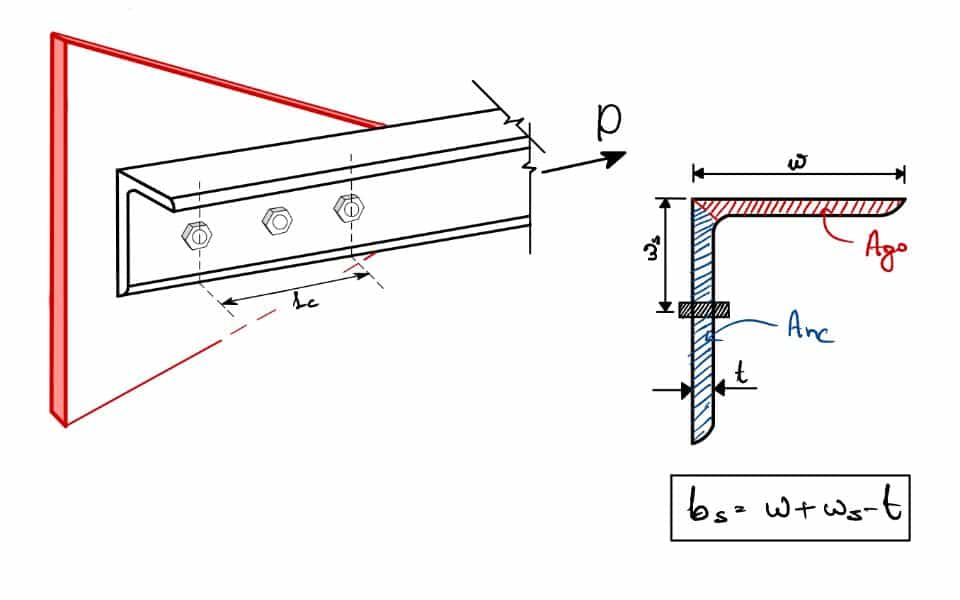
w=w= outstand leg width;

bs=b_s= shear lag width as shown in figure below;

Lc=L_c= Length of end connection as shown in figure below;

Anc=A_{nc} = Net area of the connected leg;

Ago=A_{go} = Gross area of the outstanding leg;

t=t= Thickness of the leg

Here, the β\beta factor is used for quantification of non-uniformity of stress distribution.

Design example

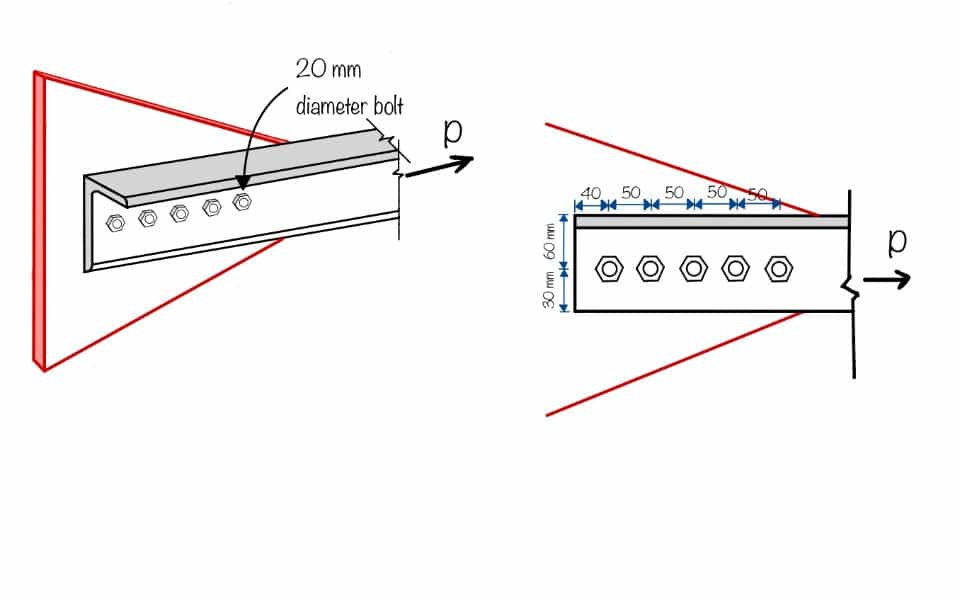
Determine the tensile capacity for the section ISA 90 ×\times 60 ×\times 8 shown below.

Given,

fy=250  MPaf_y=250\; MPa

fu=410  MPaf_u=410\; MPa

Using SP 6:Part 1, for ISA 90 ×\times 60 ×\times 8

Ag=1137  mm2A_g=1137\;mm^2

Now, design tensile strength, Td=Min(Tdg,Tdn,Tdb)T_d=\text{Min} (T_{dg},\,T_{dn},\,T_{db})

For TdgT_{dg }

Using Clause 6.2 IS 800 :2007,

Tdg=Agfy/γm0T_{dg}=A_gf_y/\gamma_{m0}

Hence,

Tdg=1137×250/1.10=258.41  kNT_{dg}=1137\times250/1.10= 258.41\; kN

For TdnT_{dn }

For single-angle, as per IS 800 :2007

Tdn=0.9Ancfu/γm1+βAgofy/γm0T_{dn}=0.9A_{nc}f_u/\gamma_{m1}+\beta A_{go}f_y/\gamma_{m0}

where,

β=\beta= 1.40.076(w/t)(fy/fu)(bs/Lc)(fuγm0/fyγm1)0.71.4-0.076(w/t)(f_y/f_u)(b_s/L_c)\leq(f_u\gamma_{m0}/f_y\gamma_{m1})\geq 0.7

In the given problem,

w=60  mmw=60\; mm; t=8  mmt=8\; mm;

bs=w+w1t=60+608=112  mmb_s=w+w_1-t=60+60-8=112\; mm

Lc=200  mmL_c =200 \; mm

Hence,

β=\beta= 1.40.076(60/8)(250/410)(112/200)=1.2051.4- 0.076 (60/8) (250/410) (112/200) =1.205

(fuγm0/fyγm1)=(410×1.10)/(250×1.25)=1.4430.7(f_u\gamma_{m0}/f_y\gamma_{m1})=(410\times1.10)/(250\times 1.25)=1.443\geq0.7

Hence, β=1.205\beta=1.205

Now,

Ago=(608/2)×8=448  mm2A_{go}=(60-8/2)\times8=448\; mm^2

Anc=(908/220)×8=528  mm2A_{nc}=(90-8/2-20)\times 8=528\; mm^2

Hence,

Tdn=0.9Ancfu/γm1+βAgofy/γm0T_{dn}=0.9A_{nc}f_u/\gamma_{m1}+\beta A_{go}f_y/\gamma_{m0}

Tdn=0.9×528×410/1.25+1.205×448×250/1.10=278.56  kNT_{dn}=0.9\times 528\times 410/1.25+1.205\times 448 \times 250/1.10=278.56\; kN

For TdbT_{db }

Tdb=Min(Tdb1,Tdb2)T_{db}=Min(T_{db_1},T_{db_2})

Which can be calculated with the two cases shown below,

Tdb1=Avgfy3γm0+0.9Atnfuγm1T_{db_1}=\frac{A_{vg}f_y}{\sqrt{3}\gamma_{m0}}+\frac{0.9A_{tn}f_u}{\gamma_{m1}}

Tdb2=0.9Avnfu3γm1+Atgfyγm0T_{db_2}=\frac{0.9A_{vn}f_u}{\sqrt{3}\gamma_{m1}}+\frac{A_{tg}f_y}{\gamma_{m0}}

Now,

Avg=240×8=1920  mm2A_{vg }=240 \times 8= 1920\;mm^2

A_{vn}= \[240 - (4.5\times 20)\]\times 8 = 1200\; mm^2

Atg=30×8=240  mm2A_{tg }= 30\times 8 = 240 \; mm^2

Atn=(300.5×20)×8=160  mm2A_{tn }=(30 - 0.5\times 20) \times 8 = 160 \; mm^2

Hence,

Tdb1=Avgfy3γm0+0.9Atnfuγm1T_{db_1}=\frac{A_{vg}f_y}{\sqrt{3}\gamma_{m0}}+\frac{0.9A_{tn}f_u}{\gamma_{m1}}

and now put the values

Tdb1=1920×2503×1.10+0.9×160×4101.25=299.17  kNT_{db_1}=\frac{1920\times250}{\sqrt{3}\times1.10}+\frac{0.9\times160\times410}{1.25}= 299.17\; kN

Tdb2=0.9Avnfu3γm1+Atgfyγm0T_{db_2}=\frac{0.9A_{vn}f_u}{\sqrt{3}\gamma_{m1}}+\frac{A_{tg}f_y}{\gamma_{m0}}

Now put the values in formula

Tdb2=0.9×1040×4103×1.25+240×2501.10=231.80  kNT_{db_2}=\frac{0.9\times1040\times410}{\sqrt{3}\times1.25}+\frac{240\times250}{1.10}=231.80\; kN

Hence, Tdb=231.80  kNT_{db}=231.80\; kN

Thus, design tensile strength, Td=Min(Tdg,Tdn,Tdb)T_d=\text{Min} (T_{dg},\,T_{dn},\,T_{db})

=(258.41  kN,278.56  kN,231.80  kN)=231.80  kN=(258.41\; kN, 278.56\; kN, 231.80\; kN) = 231.80 \; kN

Conclusions

In this article we discussed:

i) Shear lag effect exists when the load transfer takes place through only one connected leg.

ii) The calculation steps involving shear lag is explained.

Decode scientific breakthroughs using first principles.

Your trusted source for latest updates in core engineering and scientific computing.