Stability is important in the design strength of the column. In this article, we will see how to calculate the design strength of a column.

If you want to know what is column or compression member, pick up the pencil in the table in front of you, now try to compress it as shown in the figure. See, you have one compression member in your hand. This pencil is now behaving as a compression member.
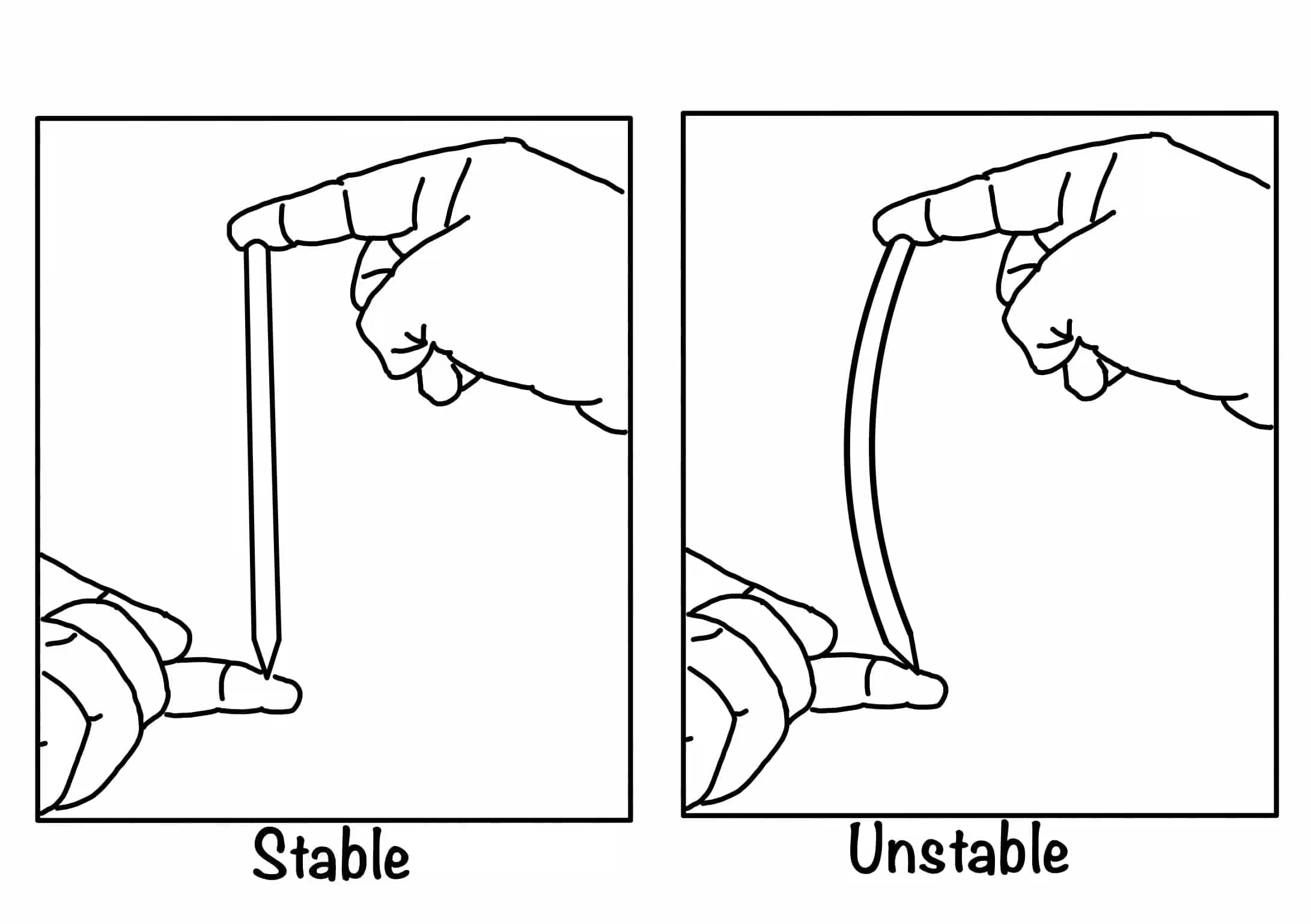
It is natural to think that the load-carrying capacity of a compression member can be found by simply multiplying its cross-sectional area by the material’s compressive strength. However, in practice, columns and compression members often fail due to buckling and instability before the material strength is reached. This is why factors like slenderness and geometry play a crucial role in compression member design.
Here comes stability, which plays an important role in the case of compression members. It reduces the strength of the compression member. Hence we need to check the strength of the compression members.
In this article we will learn about the different types of compression members, what are the important factor in the design of compression members. We will also learn the important steps in the designing of the compression members.
Compression members are those who takes compression. We classify them for our convenience so that we can understand the different types of members.
Compression members can be classified as follows:
Columns: These are straight members subjected to heavy compressive loads. Columns always remains vertical.
Strut: It is the compression members which can be tilted or horizontal. This type of compression members are subjected to light vertical loads.
Boom: These are the main members of the crane as you can see in the figure.
The main issue in the design of column is the stability. Generally when you will apply the load in the column it resist the load till the stress generated by the column is less than the strength of the column. But the instability in column reduces the strength of the column.
Hence, our main aim in the column design is to calculate the strength of the column. This strength depends on the degree of stability of the column. Now question arises how to decide the degree of stability of the column?
Don’t worry the different specific provision defined by different codes of the different countries takes care of it.
If we want to calculate the strength of the column according to IS:800-2007 steps are as follows:
Classification : Based on the section of the column we will decide the buckling class of the section from Table - 10 of IS 800:2007.
Material: Based upon the material used to build the column we will fix the strength of the column.
Stability: Now we will modify the strength of the column based on stability.
To check detailed procedure of how to do this please read the complete article.
In order to design a compression members, you need essentially one thing: Slenderness ratio of the member (). The tendency of a member to buckle (sudden change in geometry due to small change in load) is usually measured by slenderness ratio () where,
where, = Effective length factor; = Length of the member; =radius of gyration= where =Moment of Inertia about axes of the cross-section; = Area of cross-section
As per IS 800:2007, the design compressive stress is given as:
where,
Imperfection factor given in Table 7, IS 800:2007
non-dimensional effective slenderness ratio =\sqrt{\frac{f_y}{f_}{cc}}
Euler buckling stress
Stress reduction factor given in Table 8 IS 800:2007
Partial safety factor for material strength (from Table 5, IS 800:2007)
The calculated value for different buckling class is given in Table 9, IS 800:2007.
Note: The compressive design stress $f_{cd}$ can be calculated directly from Table 9 for all cross-sections except for single-angle sections.
Note: The above equation formulation is valid for all sections (I-section, Channels, etc.) but not for single-angle sections.
The definitions of are given in Clause No. 7.5.1.2, IS 800:2007.
Remember: Higher the slenderness ratio, ; Lesser the design compressive strength, .
Determine the compressive strength for the member shown below. Assume steel of grade Fe 410 .
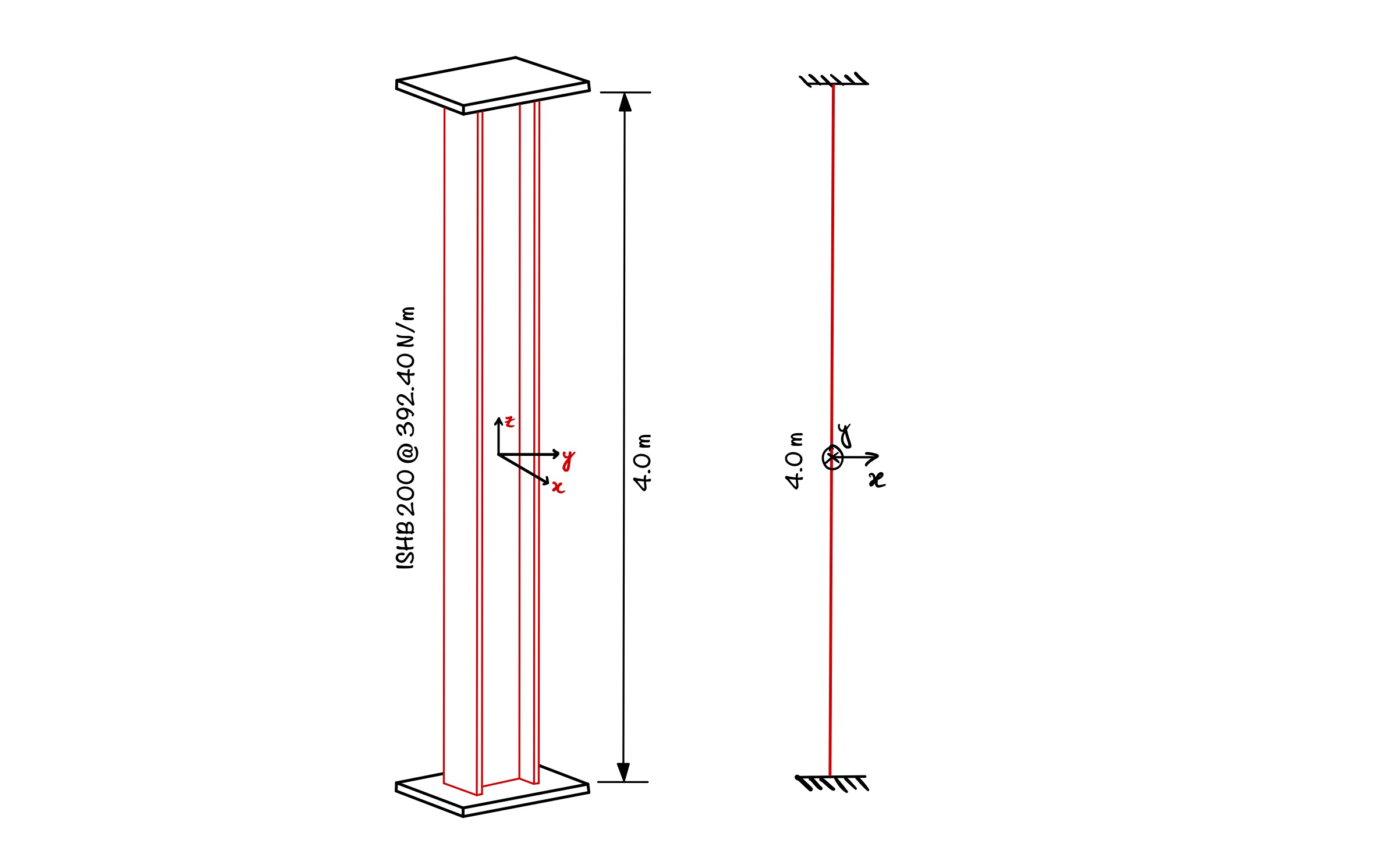
Let us solve the problem step-by-step.
Step 1: For any given problem, search for the section in SP: 6(1) and note down the cross-sectional properties such as Area of cross-section , Moment of inertia about both axes , radius of gyration about both the axes .
For the given section, ISHB 200 @392.40 \frac{N}{m}:
Step 2: Check for the boundary condition of the given problem to determine effective length, . Refer to Table 11, IS 800:2007 for value of for various boundary conditions.
We can see the boundary condition of the problem is fix-fix. Thus, referring to Table 11, IS 800:2007 for restrained - restrained conditions, .
Step 3: Calculate slenderness ratio
Now,
Taking maximum value, . (Minor axis buckling)
Note: A column can also undergo major axis buckling under different circumstances. Can you wonder how?
Step 4: Determine the buckling class for the compression member
Table 10, IS 800:2007 provides buckling classes of cross-sections based on:
Imperfection of the member (Residual stresses, initial bow, accidental eccentricity)
Type of buckling (Flexural buckling, Flexural-Torsional buckling)
For determining the buckling class, we need ratio of depth of the section and breadth of the flange i.e., and thickness of flange, .
For the given section, ISHB 200 @392.40 \frac{N}{m}:
Hence,
From Table 10, buckling class for minor axis buckling (y-y) is “buckling class b”.
Step 5: Select the suitable Table from IS 800:2007 to determine compressive stress and hence design compressive strength
The given problem is for “buckling class b” therefore select Table 9(b), IS 800:2007.
For the computed and ,
Design compressive strength,
In this article, we discussed the easy steps for determining design compressive strength as per IS 800:2007. It is worthy to note that is less than yield strength of column, . This suggests that strength of the column is based on stability.
After reading this article you have learned the following key points:
Compression members: You have learned how many different types of compression members are there. You have also learned the difference in them.
Strength: The strength of compression members is governed by stability. Hence it is very important to consider the stability issues while calculating the strength of the compression members.
Slenderness ratio: You have learned how you can calculate it and how it affect the strength of the column.
Design strength: You have also learned the calculation of design strength of the column by an example.
Your trusted source for breaking down core engineering concepts using first-principles thinking.