In structural engineering we give names to different structural members based on their behavior under applied load.
For example:
Say you have a rod of length 3 m made out of steel and a load P to support.
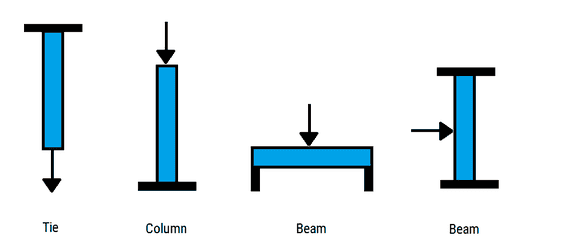
What we call a structural member depends less on what it is made of and more on how it carries load.
In all the cases discussed, the rod remains exactly the same.
Same material.
Same length.
Same cross-section.
Yet, it behaves as a tie, a column, or a beam.
The change happens only because the mode of load transfer changes—tension, compression, or bending.
This highlights a fundamental idea in structural engineering:
structural behavior defines the member, not geometry alone.
Once this idea is clear, many design concepts become intuitive.
Why columns buckle.
Why beams crack in tension.
Why ties need ductility.
Understanding members through their load path and stress behavior is the first step toward first-principle structural design—the core of how engineers think in practice.
Your trusted source for breaking down core engineering concepts using first-principles thinking.